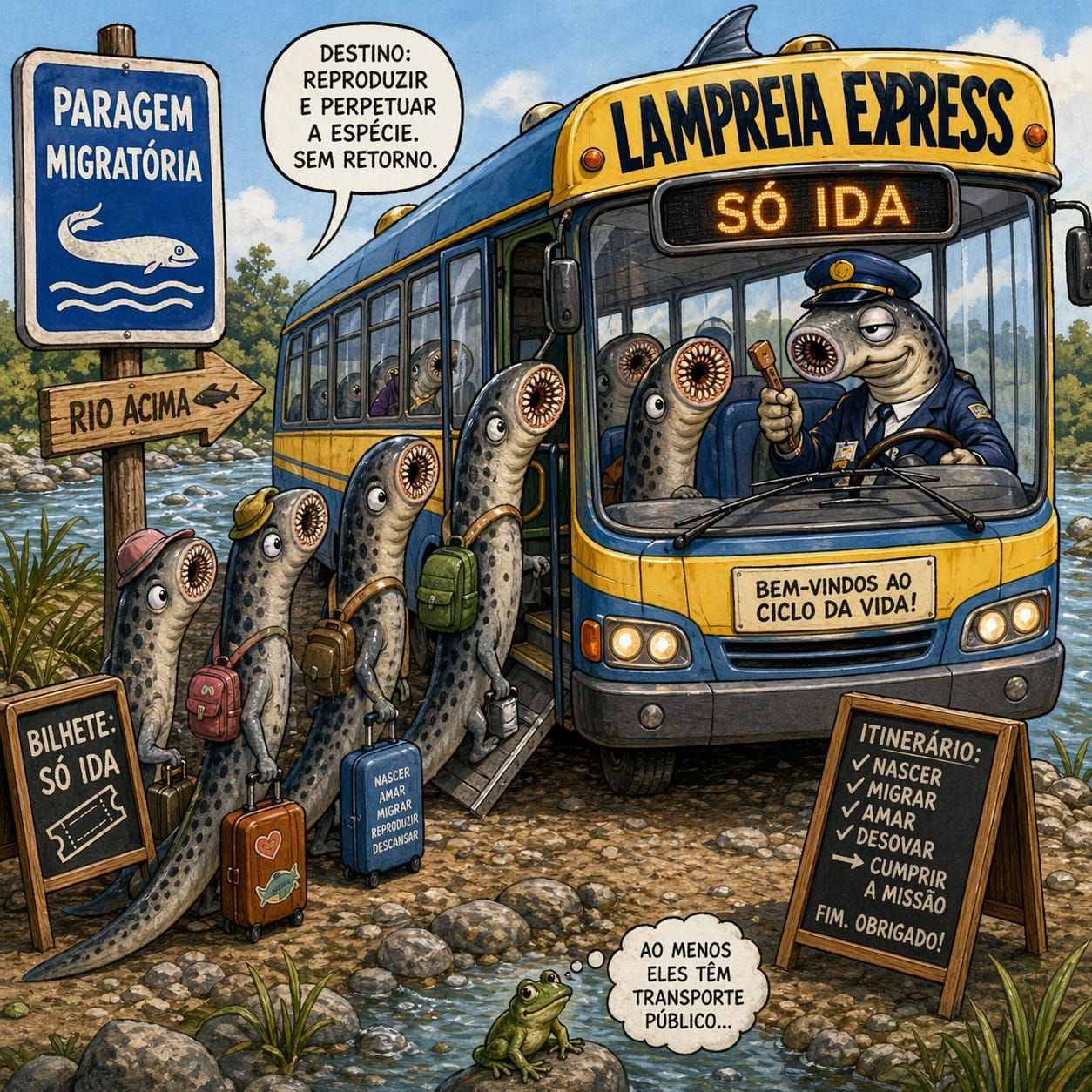
There are expressions that have something religious about them. 'The right side of history' is one of them. You don't simply say: 'we participated in an action', 'we collaborated on a project', 'we helped with a technical operation' or 'we were called to provide logistical support'. No. That would be too modest, too terrestrial, too little epic. You say: we are on the right side of history. And that's it. The phrase descends upon the river like a blessing. The waters open. The lampreys (Petromyzon marinus) get emotional. The fishers/pescadores take a deep breath. Science nods. And all of us, poor mortals on the uncertain side of history, are left trying to understand if we are facing a conservation operation, an institutional campaign, an ecological field mass or a new mode of assisted transport for fish with a migratory curriculum.
The company's publication is, in that sense, delightful. Not because of the technical content, which is as discreet as a lamprey (Petromyzon marinus) in the mud, but because of the moral security. There is a rare confidence there. After years and years of commercial activity linked to the lamprey (Petromyzon marinus), one now discovers not only the importance of the species, not only the urgency of conservation, but the exact side of history where it is convenient to be. And, luckily, that side seems to have good light, river framing and photographs usable for social media.
It is not every day that a company finds history. Much less the right side of it. There are companies that take decades to find suppliers, markets, customers, licences, margins, packaging, positioning. This one found something higher: it found public virtue. And it found it, curiously, at the moment when the conservation of the lamprey (Petromyzon marinus) started to make news. But let us not be unfair. The phrase has merit. It is prettier. It has more altitude. It gives the thing more solemnity. A company does not publish 'today we collaborated on a technical action with academic and public entities'. That would be honest, but uninspiring. One publishes 'right side of history', because conservation, when well-seasoned, can also serve as branding.
Patience, the discursive airbag of conservation
The university explains that the lamprey (Petromyzon marinus) may recover if everyone has enough patience. It is a beautiful phrase, one of those that calms any audience. All true: biology takes time, the cycle is long, nature has its own rhythms. But patience, as a scientific concept, has a small problem: it is very comfortable for those who have to wait for results and very useful for those who do not want to be held accountable too soon.
If in two years there is nothing much, it is early. If in five years there is still nothing much, more time is needed. If in seven years the recovery does not appear, perhaps the fault lies with the sea. If in ten years we continue to talk about decline, we can always conclude that patience was lacking.
Before patience, perhaps it would be worth talking about less poetic and more boring words: sanctuaries, monitoring, larval habitats, transparency, indicators, costs, responsibilities, supervision and results.
Monitoring is producing data
Translocation is visible: there are people, there is the river, there are vests, there are boxes, there is fish, there is the moment. It is perfect for the era of performative conservation. Serious monitoring, on the other hand, is a much less seductive creature: it requires sampling, records, time series, reports, comparison between years, identification of nests, evaluation of larvae, survival, public data.
Monitoring is not saying that you monitor. How many adults arrived? How many nests were confirmed? What was the spawning success? Was there detection of larvae? What indicators will define success or failure? Without this, 'monitoring' runs the risk of just being an expensive word for saying 'we were watching'.
The right side survives transparency
If someone is paid to participate, perhaps they should swap the messianic tone for a slightly more administrative tone. And if there was no payment at all, even better: publish it. 'Our participation was entirely voluntary, without financial compensation, and the costs were assumed by us.' That would be strong. That would put the conversation on another level.
Because the right side of history, when it is truly right, usually survives transparency well.
Continue exploring
From the article to the origin, to the products and to the knowledge.
Discover Karapau products or continue to Learn More to consult species, legislation, origin, sustainability and gastronomy.