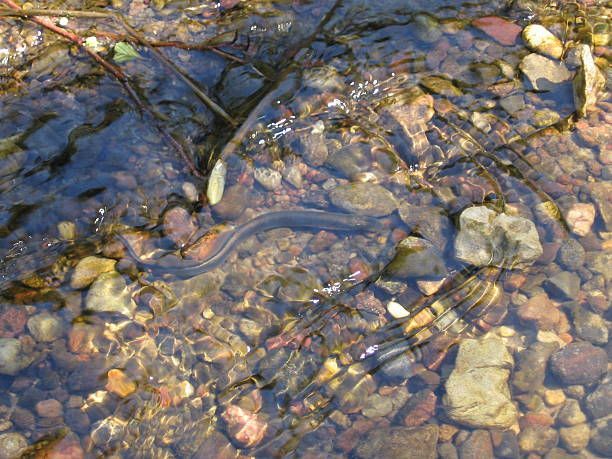
The reproduction of the sea lamprey (Petromyzon marinus) is one of the most sensitive and decisive moments in its life cycle. It is in the river, under very specific conditions, that the continuity of the species is ensured — and it is precisely for this reason that there are places that must be respected and protected. When the lamprey (Petromyzon marinus) enters the reproductive phase, it looks for areas with relatively shallow water, moderate current, and a bottom with gravel, sand, and small stones.
These locations allow it to clean the riverbed and build a natural nest through repeated body movements, displacing sediments and stabilizing a depression where egg-laying and fertilization will occur. This process, which may seem simple to the naked eye, is biologically demanding and extremely vulnerable to disturbances: it is enough to alter the substrate, step on it, drag gear, catch specimens in that location, or disturb the reproductive behavior to compromise the viability of the eggs and drastically reduce reproductive success.
This is why nesting areas are not 'just another spot in the river'. They are critical areas — true ecological cradles — and should not be the target of capture. Fishing in nesting sites means interrupting the life cycle at the exact moment when the species is trying to regenerate. It means reducing recruitment, that is, the entry of new juveniles into the population. And without recruitment, there is no natural replacement. In the medium term, the result is always the same: fewer lamprey (Petromyzon marinus) in the river, greater fragility of the ecosystem, and an irreversible loss of a heritage that belongs to everyone.
In rivers where mortality is higher — due to the cumulative pressure of factors such as barriers to migration, habitat degradation, flow alterations, pollution, and capture pressure — natural recruitment becomes even more decisive. The greater the mortality and the greater the environmental stress, the greater the dependence on successful reproduction to compensate for losses and allow for population recovery.
Sustainability, in practice, is this: understanding the biological cycle, respecting critical moments, and acting with awareness. It is knowing that there are places where you do not fish because you do not take from there — there, life is built. The continuity of the lamprey (Petromyzon marinus) is not defended with beautiful words: it is defended with respect for the river, the nests, and the future.
Continue exploring
From the article to the origin, to the products and to the knowledge.
Discover Karapau products or continue to Learn More to consult species, legislation, origin, sustainability, and gastronomy.