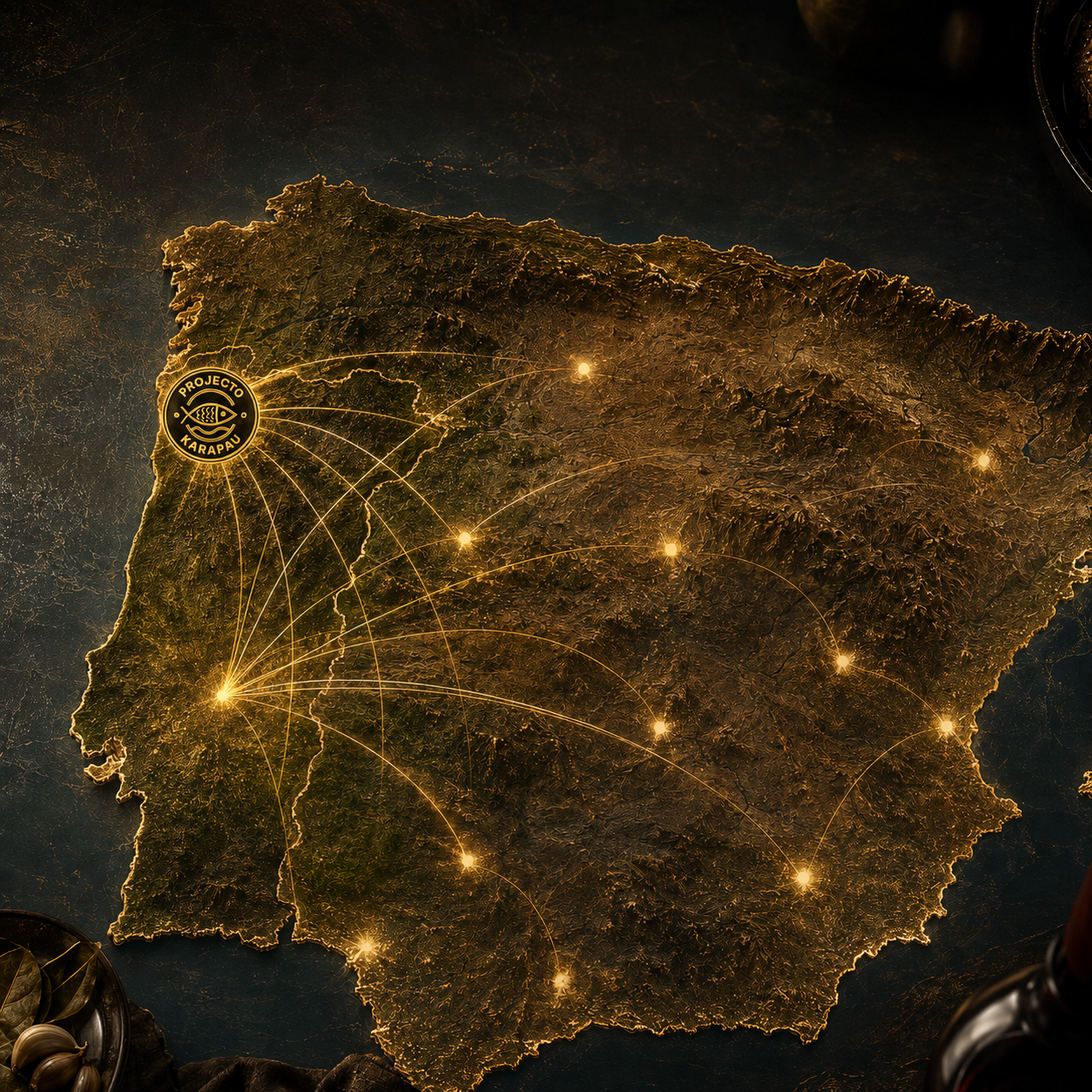
Over the last year, Karapau worked on a goal that, to many, seemed too ambitious: to take Portuguese lamprey (Petromyzon marinus) ready for cooking directly to the Spanish consumer. And it is worth starting by clarifying the obvious. When Karapau speaks of reaching Spain, it does not mean putting a live lamprey (Petromyzon marinus) in a bag, putting it in a van, and crossing the border with a triumphant air. It also does not mean asking a Spanish customer to come to Portugal to pick up the product, nor making a delivery near the border and calling that internationalization.
Karapau was talking about something else. It was talking about process. It was talking about taking to Spain a Portuguese lamprey (Petromyzon marinus) that is prepared, marinated, packaged, labeled, identified, and ready to cook. It was talking about delivering to the Spanish consumer not a problem, but a gastronomic solution.
The invisible work
For months, the company worked away from the usual noise. Packaging details were reviewed, labeling information adjusted, authorizations studied, logistics processes improved, preservation conditions analyzed, and changes made to ingredients to adapt the product to a more demanding operation. It was work that was not very flashy, not very photogenic, and very inconvenient for those who like to sell great achievements without going through the boring part of compliance. But it is precisely this invisible work that separates a brand from an attempt, an operation from an adventure.
After some delay beyond what was expected — because when one works with rigor, almost nothing happens at the speed of beautiful sentences — Karapau began its first real approaches to the Spanish market. In a few days, the Portuguese lamprey (Petromyzon marinus) ready to cook reached different points in Spain, including locations far from each other, with direct deliveries to the final consumer. It was not a symbolic experience. It was not a border sale. It was not 'almost Spain'. It was Spain itself: Spanish addresses, Spanish customers, prepared product, and full service.
The answer could not have been clearer
The deliveries generated positive comments and showed that the Spanish palate recognizes quality when it arrives well-presented. After all, perhaps Spain was never the problem. Perhaps the problem was just in the small, old, and somewhat comfortable way that some imagined getting there. The Spanish consumer did not need a live lamprey (Petromyzon marinus) delivered as a domestic challenge, nor a tradition transformed into an obstacle. They needed confidence, explanation, quality, and service.
KARAPAU has developed a preparation and marketing model for lamprey (Petromyzon marinus) aimed at facilitating consumer access to a traditional product, through processes of preparation, packaging, batch identification, and customer information — a model also designed for domestic consumption in Spain. This is not a comparison with other operators: it is a description of the process we follow.
Karapau did not just take lamprey (Petromyzon marinus) to Spain; it took a model. A model in which tradition is not used as an excuse for keeping everything the same, but as a reason to do better. A model in which the lamprey (Petromyzon marinus) ceases to depend exclusively on informality, live sales, complex preparation, and the almost heroic idea that the customer has to suffer to deserve to eat well.
In the end, the difference is simple. There are those who cross borders to say they arrived. And there are those who actually arrive.
For Portuguese and Spanish customers who want to try Karapau lamprey (Petromyzon marinus), the process is simple: the lamprey (Petromyzon marinus) arrives prepared, marinated, packaged, and ready to cook at home, with free delivery in Portugal and Spain. Then, it's just a matter of doing the most important part: sauté, simmer, and serve.
Editorial note (November 2, 2026). The drafting of this article has been revised: the claims of pioneering, exclusivity, and certification have been replaced by a description of the procedure adopted by KARAPAU. The original publication date remains.
Continue exploring
From the article to the origin, to the products and to the knowledge.
Discover Karapau products or continue to Know More to consult species, legislation, origin, sustainability and gastronomy.